
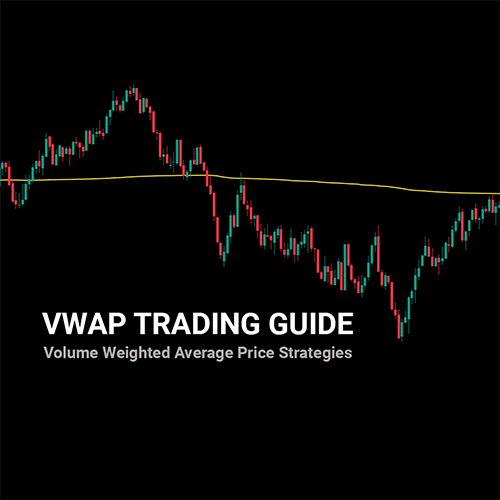
VWAP, or Volume Weighted Average Price, represents the average price a security has traded at throughout the day, weighted by volume. Unlike simple moving averages that treat all price points equally, VWAP gives more weight to prices where higher volumes occurred. This makes it one of the most reliable benchmarks for intraday trading, used by both institutional traders and retail day traders to gauge fair value and identify high-probability trade setups. Many traders apply VWAP strategies when trading with funded accounts or prop firms, where position size and execution quality matter significantly.
The indicator appears as a single line on your chart that resets at the start of each trading session. When price trades above VWAP, it indicates buyers are in control and the security is trading at a premium to its volume-weighted average. When price falls below VWAP, sellers dominate and the security trades at a discount.
Understanding VWAP in Trading
VWAP stands for Volume Weighted Average Price and calculates the ratio of the value traded to total volume traded over a specific time period. For most traders, this means from market open to market close on a single trading day.
The indicator serves three critical functions. First, institutional traders use VWAP as an execution benchmark—buying below VWAP or selling above it indicates favorable execution quality. Second, VWAP acts as dynamic support and resistance, with price often respecting it as a key level throughout the session. Third, consistent price action above or below VWAP confirms trend direction and market sentiment.
Why Volume Weighting Matters
Traditional moving averages calculate the average of closing prices over a set number of periods, giving equal weight to each bar regardless of how much volume traded. VWAP improves on this by incorporating volume into the calculation.
Consider a stock that trades 100 shares at $50 and 1,000,000 shares at $51. A simple moving average would treat both price points equally, but VWAP recognizes that the overwhelming majority of volume occurred at $51. This volume-weighted approach provides a more accurate picture of where the real money traded hands.
Large institutional orders often move markets. By weighting price by volume, VWAP shows you where institutions likely established their positions, making it invaluable for understanding the true average entry price of market participants.
VWAP Formula and Calculation
The VWAP calculation uses a straightforward formula:
VWAP = Cumulative (Price × Volume) ÷ Cumulative Volume
Where Price typically equals (High + Low + Close) ÷ 3 for each period, also called the typical price.
Step-by-Step VWAP Calculation Example
Let's calculate VWAP for the first three 5-minute bars of a trading session to understand how it works in practice.
Bar 1:
High = $100.50
Low = $100.00
Close = $100.25
Volume = 10,000 shares
Typical Price = ($100.50 + $100.00 + $100.25) ÷ 3 = $100.25 Price × Volume = $100.25 × 10,000 = $1,002,500
Bar 2:
High = $100.75
Low = $100.25
Close = $100.50
Volume = 15,000 shares
Typical Price = ($100.75 + $100.25 + $100.50) ÷ 3 = $100.50 Price × Volume = $100.50 × 15,000 = $1,507,500
Bar 3:
High = $100.60
Low = $100.30
Close = $100.40
Volume = 12,000 shares
Typical Price = ($100.60 + $100.30 + $100.40) ÷ 3 = $100.43 Price × Volume = $100.43 × 12,000 = $1,205,160
Final VWAP Calculation:
Cumulative (Price × Volume) = $1,002,500 + $1,507,500 + $1,205,160 = $3,715,160
Cumulative Volume = 10,000 + 15,000 + 12,000 = 37,000 shares
VWAP = $3,715,160 ÷ 37,000 =
$100.41
This calculation continues throughout the trading session, with each new bar adding to the cumulative totals. Your trading platform calculates this automatically in real-time, so you never need to compute it manually. However, understanding the math helps you grasp why VWAP behaves the way it does.
How to Read VWAP Signals
VWAP provides clear directional signals based on price position relative to the indicator line.
Price Above VWAP signals bullish sentiment and strong buying pressure. The market is trading at a premium to the volume-weighted average, suggesting buyers are willing to pay higher prices. Many traders look for pullbacks to VWAP as potential long entry points when price is above the line.
Price Below VWAP indicates bearish sentiment and selling pressure. The market trades at a discount to the average price, showing sellers control the auction. Traders often look for bounces to VWAP as potential short entry opportunities.
Price at VWAP represents equilibrium between buyers and sellers. When price consolidates at VWAP, it often precedes a significant move in either direction. Watch for breakouts above or breakdowns below as directional signals.
VWAP as Dynamic Support and Resistance
VWAP functions as a support and resistance level that adjusts throughout the trading day. In uptrends, price often finds support when pulling back to VWAP. In downtrends, VWAP frequently acts as resistance when price rallies.
The strength of VWAP as support or resistance depends on several factors. Multiple successful tests strengthen VWAP's significance as a level. Higher volume when price reaches VWAP indicates stronger institutional interest at that level. VWAP becomes more reliable as the trading session progresses and more data accumulates. Finally, VWAP support works best in uptrends, while VWAP resistance is most effective in downtrends.
When combining VWAP with other support and resistance analysis, look for confluence zones where VWAP aligns with previous day's highs and lows, round numbers, or major pivot points. These confluence areas create even stronger technical zones.
VWAP Trading Strategies
Successful VWAP trading relies on combining the indicator with price action, volume analysis, and proper risk management. Here are proven strategies used by professional day traders.
VWAP Bounce Strategy
The VWAP bounce strategy capitalizes on price rejections at the VWAP line. This approach works best in trending markets where VWAP acts as dynamic support or resistance.
Long Position Setup:
Identify an established uptrend with price consistently above VWAP
Wait for price to pull back to VWAP
Look for bullish price action signals at VWAP—bullish engulfing candles, hammer patterns, or increasing volume on the bounce
Enter long when price bounces off VWAP with confirmation
Place stop loss below the recent swing low or slightly below VWAP
Target previous highs or use a 2:1 or 3:1 reward-risk ratio
Short Position Setup:
Identify a clear downtrend with price staying below VWAP
Wait for price to rally to VWAP
Watch for bearish reversal signals at VWAP—bearish engulfing patterns, shooting stars, or rejection wicks
Enter short when price rejects VWAP
Set stop loss above the recent swing high or just above VWAP
Target previous lows or maintain favorable risk-reward ratios
The key to this strategy is patience. Wait for price to actually reach VWAP and show you a clear rejection before entering. Premature entries often result in whipsaw losses.
VWAP Breakout Strategy
VWAP breakouts occur when price decisively moves through VWAP after consolidating near it. These breakouts often lead to strong directional moves because they trigger both long entries from bulls and short covering from bears.
Bullish Breakout Rules:
Price consolidates at or below VWAP
Volume contracts during consolidation
Price breaks above VWAP with expanding volume
Enter on the breakout candle or on a micro-pullback to VWAP
Stop loss below VWAP
Target measured move based on consolidation range
Bearish Breakout Rules:
Price consolidates at or above VWAP
Volume decreases during the range
Price breaks below VWAP with increasing volume
Enter on the breakdown or on a brief rally back to VWAP
Stop loss above VWAP
Target measured move lower
Volume confirmation is critical for breakout trades. Without expanding volume, breakouts often fail and reverse. Many traders combine VWAP breakouts with candlestick patterns for additional confirmation.
Combining VWAP with Moving Averages
Many professional traders enhance VWAP strategies by adding exponential moving averages (EMAs) to their charts. The most popular combination uses VWAP with the 9 EMA and 20 EMA.
Multi-Indicator Setup:
When price trades above VWAP and both EMAs align above it, bullish bias is confirmed. Look for pullbacks to the 9 EMA or 20 EMA as entry opportunities. The 9 EMA crossing above the 20 EMA provides additional confirmation of upward momentum.
Conversely, when price trades below VWAP with both EMAs positioned below it, bearish bias is strong. Rallies back to the 9 EMA or 20 EMA offer short entry opportunities. The 9 EMA crossing below the 20 EMA confirms downward momentum.
This layered approach reduces false signals and helps you trade in the direction of the strongest momentum. Moving average crossovers combined with VWAP position create high-probability setups.
VWAP Mean Reversion Strategy
The mean reversion strategy assumes that price tends to return to VWAP after moving too far away from it. This works best in range-bound or choppy market conditions.
Setup Requirements:
Most platforms allow you to add standard deviation bands around VWAP, similar to Bollinger Bands. Common settings include 1, 2, and 3 standard deviations.
When price reaches the 2nd or 3rd standard deviation band away from VWAP, it's statistically extended. Mean reversion traders look for reversal signals at these extremes, expecting price to snap back toward VWAP.
Long Mean Reversion:
Price hits lower 2nd or 3rd deviation band
Look for bullish reversal candlestick patterns
Enter long targeting a move back to VWAP
Stop loss beyond the deviation band
Short Mean Reversion:
Price reaches upper 2nd or 3rd deviation band
Watch for bearish reversal patterns
Enter short targeting VWAP
Stop loss above the deviation band
This strategy requires strict discipline. Don't fight strong trends. Mean reversion works in ranging markets but fails in powerful trending environments where price can remain extended for long periods.
Using VWAP for Different Markets
VWAP adapts to various financial markets, though its application and reliability vary by asset class.
VWAP for Stock Trading
VWAP originated in equity markets and remains most effective for stock trading. The indicator works exceptionally well for liquid stocks with consistent volume throughout the trading day.
Best Applications:
Large-cap stocks like AAPL, MSFT, TSLA, and NVDA show highly reliable VWAP behavior due to consistent volume and heavy institutional participation. High-volume momentum stocks benefit from VWAP as institutions often use it for execution benchmarking. Stocks that gap up on news frequently respect VWAP as support throughout the session.
Stock-Specific Considerations:
Avoid using VWAP on low-volume stocks where sporadic trading creates erratic VWAP movements. Stocks with average daily volume below 500,000 shares often produce unreliable VWAP signals. Exercise caution during earnings announcements or major news events that create abnormal volume spikes, as these can distort VWAP for the remainder of the session.
VWAP for Futures Trading
VWAP translates exceptionally well to futures markets, particularly for index futures like ES (E-mini S&P 500), NQ (E-mini Nasdaq), and YM (E-mini Dow). Futures trade nearly 24 hours, so VWAP typically resets at the official market open—usually 9:30 AM ET for U.S. equity index futures.
Futures-Specific Advantages:
Extremely high liquidity ensures consistent VWAP reliability across the session. Lower transaction costs and favorable leverage compared to stocks make futures attractive for VWAP strategies. The ability to trade both directions equally makes VWAP bounce strategies effective in both uptrends and downtrends.
Extended Hours Considerations:
Futures markets experience significant volatility outside regular trading hours. Pre-market moves can position the regular session VWAP far from current price. Many traders use anchored VWAP starting at the overnight session open rather than the standard daily VWAP to account for extended hours trading.
VWAP with Prop Firm Futures Trading
Futures trading with prop firms has become increasingly popular among VWAP traders due to the combination of leverage, buying power, and the indicator's reliability on highly liquid futures contracts. Prop firms provide traders access to simulated capital, allowing them to implement VWAP strategies on contracts like ES, NQ, and crude oil without risking personal funds.
Why VWAP Works Well with Prop Firm Trading:
Prop firm evaluation accounts typically range from $25,000 to $250,000 in simulated capital, giving traders sufficient position sizing flexibility to properly scale into VWAP setups. The consistent volatility and volume in futures markets during regular trading hours make VWAP particularly reliable for meeting prop firm profit targets while managing drawdown limits.
Most prop firms impose daily loss limits and maximum drawdown rules. VWAP's clear support and resistance levels help traders set precise stop losses that respect these risk parameters. For example, placing stops just below VWAP on long positions or just above VWAP on short positions provides logical, rule-based risk management that aligns well with prop firm requirements.
Optimal Contracts for VWAP Prop Trading:
The ES (E-mini S&P 500) shows exceptional VWAP respect during the 9:30 AM to 4:00 PM ET session. The deep liquidity ensures tight spreads and minimal slippage, critical when trading with prop firm capital where every tick matters toward profit targets.
The NQ (E-mini Nasdaq) offers larger point movements, allowing traders to hit prop firm profit targets more quickly. However, its increased volatility requires wider stops, which must be considered within daily loss limits.
Crude oil futures (CL) demonstrate strong VWAP behavior during peak trading hours, particularly around inventory reports and economic data releases. The contract's volatility can help ambitious traders reach evaluation targets faster, though it requires strict discipline.
Adapting VWAP Strategies for Prop Firm Rules:
Prop firms typically require traders to achieve specific profit targets—often 8-10% of account size—while staying within maximum daily loss limits of 2-5%. VWAP strategies adapt well to these constraints through careful position sizing and target selection.
A common approach uses VWAP bounce entries with targets at the previous swing high or a 2:1 reward-risk ratio, whichever comes first. This provides multiple opportunities throughout the day to chip away at profit targets without overexposing the account.
Some traders use VWAP exclusively during the first two hours of the futures session (9:30-11:30 AM ET) when volume and volatility are highest. This concentrated trading window allows them to capitalize on the clearest VWAP signals while avoiding the choppy, low-volume conditions that often emerge during lunch hours.
Risk Management Considerations:
Prop firms immediately disqualify traders who violate maximum loss limits. VWAP's defined support and resistance levels help maintain disciplined risk management. Never risk more than 0.5-1% of your simulated account size per trade, even when VWAP signals appear strong.
Consider that prop firm accounts often provide substantial leverage (10:1 or higher on futures). While this amplifies profit potential, it also means poor entries can quickly approach daily loss limits. Wait for clear VWAP confirmations—such as volume surges at the level or decisive candlestick patterns—before entering positions.
Multiple false signals can occur when price consolidates directly at VWAP. In prop firm trading where preservation of capital is paramount, it's often better to wait for price to move away from VWAP and then look for the bounce or rejection, rather than trying to predict the direction from equilibrium.
VWAP for Forex Markets
VWAP application in forex requires special consideration because forex operates 24 hours with no official opening or closing bell. This creates challenges for traditional VWAP calculations.
Forex VWAP Adaptations:
Set VWAP to reset at midnight GMT or your local timezone. Some traders prefer session-specific VWAP, resetting at the start of London (8:00 AM GMT) or New York (1:00 PM GMT) sessions. Use VWAP primarily on major pairs like EUR/USD, GBP/USD, and USD/JPY where volume is most consistent.
Forex Limitations:
Forex volume data from retail brokers represents tick volume or broker-specific volume, not true market volume since forex is decentralized. This makes VWAP less reliable in forex compared to centralized exchanges. Different brokers may show different VWAP values due to varying volume data, so VWAP works better as a relative guide rather than an absolute level.
VWAP for Cryptocurrency
Cryptocurrency markets share characteristics with forex, including 24-hour trading. However, centralized crypto exchanges do provide accurate volume data, making VWAP more reliable than in forex.
Crypto VWAP Best Practices:
Use VWAP on major cryptocurrencies like BTC, ETH, and other top 20 coins by market cap. Set VWAP to reset at midnight UTC for global consistency. Focus on spot markets rather than perpetual futures for more accurate volume. Consider using exchange-specific VWAP, as volume differs significantly across exchanges.
Crypto-Specific Challenges:
Cryptocurrency markets experience extreme volatility that can render VWAP less effective during major moves. Weekend trading creates gaps in participation that may cause Monday's VWAP to start far from Friday's close. Wash trading and artificial volume on some exchanges can distort VWAP calculations, so stick to reputable exchanges with genuine volume.
Adding VWAP to Your Charts
Most trading platforms include VWAP as a built-in indicator. Here's how to add it on popular platforms.
VWAP on TradingView
Click the Indicators button at the top of your chart
Search for "VWAP" in the search box
Select "VWAP" from the built-in indicators (created by TradingView)
The indicator appears on your chart as a single line
Customization Options:
Click the gear icon next to VWAP in your indicator list to access settings. You can adjust the anchor period (Session, Week, Month, Year, or custom), change line color and thickness, add standard deviation bands, and modify the source price (HLC3 is the default).
Anchored VWAP:
TradingView includes an Anchored VWAP tool in the drawing toolbar. Click the Anchored VWAP icon, then click on your chart at the starting point you want. This creates a VWAP calculation beginning at your selected point rather than the session open.
VWAP on Thinkorswim
Open your chart and click Studies in the top menu
Select Add Study, then Edit Studies
Search for "VWAP" in the search box
Click on VWAP and select Add
Click OK to apply the study
Thinkorswim allows extensive customization including time period adjustments, custom formulas for different VWAP calculations, colors and line styles, and the ability to overlay multiple VWAP studies with different settings.
VWAP on NinjaTrader
Right-click on your chart
Select Indicators from the menu
Scroll down or search for "VWAP"
Double-click VWAP or select it and click Add
Configure settings and click OK
NinjaTrader's VWAP includes session templates for different markets, standard deviation bands, customizable colors and plot styles, and options to display VWAP values in the data box. The platform also supports custom VWAP indicators from third-party developers.
VWAP vs Anchored VWAP
While traditional VWAP resets each trading day, Anchored VWAP allows traders to set a custom starting point for the calculation.
Standard VWAP
Standard VWAP automatically resets at the beginning of each trading session, typically at market open. This version measures the average price weighted by volume from the session start to the current moment.
When to Use Standard VWAP:
Day trading with positions closed by end of day works perfectly with standard VWAP. It's ideal for measuring institutional participation during normal market hours, comparing current price to the day's volume-weighted average, and providing a quick intraday reference without complex analysis.
Anchored VWAP
Anchored VWAP starts the calculation from a specific point chosen by the trader rather than the session open. This could be a major event, significant price level, or any moment the trader deems important.
Common Anchor Points:
Anchor VWAP at the exact time of earnings announcements to track the market's reaction. Set VWAP from significant swing highs or lows to measure retracement or continuation. Anchor from the moment a stock gaps to track whether the gap fills or holds. Start VWAP when major news hits to gauge market absorption of information. Anchor VWAP at breakout candles to track the average entry price of breakout traders.
Key Differences
Standard VWAP provides a consistent daily benchmark that everyone sees, making it more significant as a support and resistance level. Anchored VWAP offers customized analysis specific to your trading thesis but lacks the universal recognition of standard VWAP.
Standard VWAP works better for pure day trading, while Anchored VWAP excels for swing trading or tracking longer-term moves. Advanced traders use both simultaneously—standard VWAP for overall market bias and anchored VWAP from specific events to track particular moves.
VWAP Indicator Settings and Customization
Understanding VWAP settings helps you optimize the indicator for your trading style.
Source Price Settings
The source price determines which price data VWAP uses for calculations. Most platforms default to HLC3, which equals (High + Low + Close) ÷ 3, also called the typical price.
Alternative Options:
Close uses only closing prices for end-of-bar precision. OHLC4 averages Open, High, Low, and Close for the most comprehensive representation. HL2 uses (High + Low) ÷ 2, excluding close price.
For most applications, stick with the default HLC3 setting. Changing the source price creates a different VWAP line that other traders won't see, reducing its effectiveness as a widely-watched level.
Standard Deviation Bands
Many platforms allow you to add standard deviation bands around VWAP, measuring how far price deviates from the average.
Common Settings:
1st standard deviation (1.0) shows normal price deviation. 2nd standard deviation (2.0) indicates extended moves. 3rd standard deviation (3.0) signals extremely overbought or oversold conditions.
Traders use VWAP bands for mean reversion opportunities. When price reaches the 2nd or 3rd standard deviation band, it often reverses back toward VWAP. The bands also help set profit targets, with the opposite band serving as a logical exit point.
Reset Period Options
The reset period determines when VWAP starts its calculation fresh. Standard setting resets VWAP at the beginning of each trading session.
Alternative Resets:
Weekly VWAP resets at the start of each week, useful for swing traders. Monthly VWAP resets monthly, relevant for longer-term position traders. Never reset creates continuous VWAP from a specific starting point, essentially functioning as anchored VWAP.
Day traders should stick with the daily reset. Swing traders might experiment with weekly VWAP for a broader perspective on institutional positioning over multiple sessions.
Common VWAP Trading Mistakes to Avoid
Even experienced traders make mistakes when using VWAP. Here are the most common pitfalls and how to avoid them.
Using VWAP in Low Volume Conditions
VWAP accuracy degrades significantly when volume is light. Thin trading can cause price to whipsaw around VWAP without meaningful signals. Always check average daily volume before relying on VWAP signals. Stocks below 500,000 average daily volume often produce unreliable VWAP behavior.
Ignoring the Broader Trend
VWAP works best when aligned with the larger trend. Fighting the daily or weekly trend using only VWAP signals often leads to losses. Before taking VWAP bounce trades, confirm you're trading in the direction of the higher timeframe trend. This is where combining VWAP with moving averages or other trend indicators proves valuable.
Late Session VWAP Lag
As the trading session progresses, VWAP becomes increasingly lagged because it's based on cumulative data from the entire day. By 3:00 PM, VWAP resembles a very long moving average and may not accurately reflect current price action. VWAP signals are most reliable during the first few hours of the trading session when the indicator is more responsive to recent price movement.
Over-Relying on VWAP Alone
VWAP is powerful but should never be your only indicator. The best VWAP traders combine it with volume analysis, candlestick patterns, support and resistance levels, and momentum indicators like RSI or MACD. Multiple confirmations reduce false signals and improve win rates.
Misunderstanding VWAP's Purpose
VWAP is primarily a day trading tool designed for intraday analysis. It resets daily and loses effectiveness for swing trading or position trading. If you're holding positions overnight, VWAP provides limited value. Focus on moving averages and other multi-day indicators instead.
VWAP Frequently Asked Questions
What does VWAP stand for?
VWAP stands for Volume Weighted Average Price. It calculates the average price of a security weighted by the volume traded at each price level throughout the trading day.
Is VWAP better than moving averages?
VWAP isn't necessarily better than moving averages—they serve different purposes. VWAP weights price by volume and resets daily, making it ideal for intraday trading and understanding where institutional money traded. Moving averages smooth price trends across multiple days and work better for swing trading and identifying longer-term trends. Many traders use both together for different timeframes.
Can I use VWAP for swing trading?
Standard VWAP, which resets daily, is designed for day trading and less suitable for swing trading. However, Anchored VWAP works well for swing traders because it calculates from a specific point like a breakout or earnings announcement rather than resetting daily. Weekly or monthly VWAP can also serve swing traders looking for longer-term average prices.
What timeframe works best for VWAP?
VWAP works on any intraday timeframe since it's calculated from cumulative session data. Popular choices include 1-minute charts for scalpers, 5-minute charts for active day traders (most common), 15-minute charts for cleaner signals with less noise, and 30-minute to hourly charts for longer intraday holds. The timeframe you choose depends on your trading style and how quickly you want to enter and exit positions.
How accurate is VWAP?
VWAP accuracy depends on volume conditions and proper application. In liquid markets with consistent volume, VWAP is highly accurate and reliable. It becomes less accurate in low-volume stocks, during unusual news events, late in the trading session, and in 24-hour markets like forex where volume data is less reliable. VWAP is most accurate during the first 1-3 hours of the trading session in high-volume securities.
What's the difference between VWAP and TWAP?
VWAP (Volume Weighted Average Price) weights each price by its trading volume, giving more importance to prices where heavy volume occurred. TWAP (Time Weighted Average Price) simply averages price over time without considering volume, treating each time period equally. VWAP provides a more accurate picture of where real money traded hands, while TWAP treats all time periods the same regardless of trading activity.
Should I use VWAP for scalping?
Yes, VWAP works excellently for scalping strategies. Scalpers use VWAP to quickly identify if they're buying below or selling above the average price, providing instant feedback on trade quality. Quick bounces off VWAP and rapid mean reversion to VWAP from deviation bands create frequent scalping opportunities. Use 1-minute or 5-minute charts for scalping with VWAP and always confirm with volume.
Does VWAP work in pre-market trading?
Standard VWAP typically doesn't calculate during pre-market hours since it resets at the regular market open. However, you can use Anchored VWAP starting at the pre-market open to track the volume-weighted average price from the start of pre-market trading. Some platforms offer extended hours VWAP that begins calculating when pre-market opens. Keep in mind that pre-market volume is generally lower, which may reduce VWAP reliability.
How do I know if VWAP is working?
VWAP is "working" when price respects it as support or resistance through multiple tests. Signs VWAP is effective include price bouncing off VWAP multiple times, volume increasing when price approaches VWAP, price reversing at VWAP standard deviation bands, and VWAP acting as a magnet during choppy price action. If price is repeatedly slicing through VWAP without respecting it, the indicator may not be useful for that particular security or session.
Can I use VWAP on all stocks?
VWAP works best on liquid stocks with consistent volume. Large-cap stocks, high-volume mid-cap stocks, actively traded small-cap stocks, and stocks with clear institutional interest show the most reliable VWAP behavior. Avoid using VWAP on low-volume penny stocks, illiquid securities with sporadic trading, stocks with average volume below 500,000 shares, and heavily manipulated low-float stocks. Always check volume characteristics before relying on VWAP.
Disclaimer: Trading stocks, futures, forex, and cryptocurrencies involves substantial risk of loss and is not suitable for all investors. Past performance is not indicative of future results. The information provided in this article is for educational purposes only and should not be considered financial advice. Always conduct your own research and consider consulting with a licensed financial advisor before making trading decisions. VWAP and other technical indicators are tools for analysis but do not guarantee profitable trades.

Alpha Futures Standard Plan Guide: Rules, Pricing & Payouts
Learn how the Alpha Futures Standard Plan works, including account sizes, pricing, profit targets, drawdown limits, consistency rules, activation fees, payout policies, and the key differences between the Standard Plan and other Alpha Futures accounts.
Alpha Futures Zero Account Guide: Rules, Payouts and Cost
Learn how the Alpha Futures Zero Plan works with exact rules, pricing, payout requirements, and profit split. See how to pass the evaluation and start getting payouts fast.

Complete LucidBlack Guide: 3-day Payouts & 2x Bonus System
Complete guide to LucidBlack covering 3-day payouts, 2x bonus system, evaluation rules, funded account requirements, 40% consistency, contract scaling, LucidLive transition, and detailed comparisons with LucidFlex, LucidPro, and LucidDirect.