
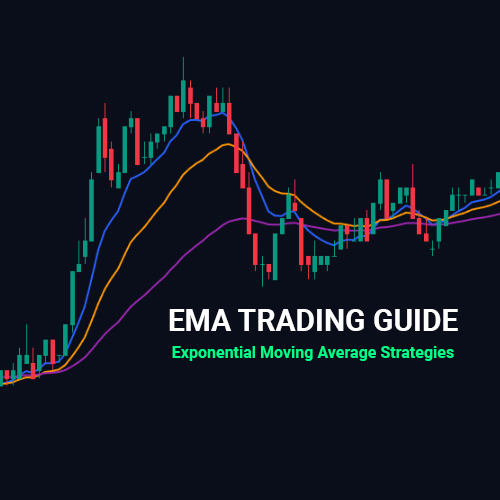
The Exponential Moving Average (EMA) is a technical indicator that calculates the average price of a security over a specific period while giving greater weight to recent prices. This weighting mechanism makes EMA more responsive to current price movements compared to the Simple Moving Average (SMA), which treats all price points equally. Traders use EMA to identify trends, spot potential entry and exit points, and confirm momentum across stocks, futures, forex, and cryptocurrency markets.
The indicator appears as a smooth line on price charts that follows price action more closely than traditional moving averages. When price trades above a rising EMA, it signals bullish momentum. When price falls below a declining EMA, it indicates bearish pressure. The EMA's responsiveness to recent data makes it particularly valuable for short-term trading strategies and fast-moving markets.
Many traders combine EMA with other technical indicators for stronger confirmation signals. Popular combinations include EMA with VWAP for volume-weighted positioning, Bollinger Bands for volatility analysis, and RSI for momentum confirmation. Professional traders often apply these EMA strategies when trading with prop firms, where proper risk management and consistent strategy execution are essential for maintaining funded accounts.
Understanding EMA in Trading
The Exponential Moving Average differs fundamentally from other moving averages through its calculation method. While a Simple Moving Average adds up closing prices over a set period and divides by the number of periods, EMA applies a multiplier that gives exponentially more weight to recent prices.
This exponential weighting means that a 20-day EMA doesn't just look at the last 20 days equally. Instead, today's price carries more influence than yesterday's, yesterday's more than the day before, and so on. The weighting decreases exponentially as you go further back in time, but mathematically, an EMA incorporates data from all previous prices, with the most recent data having the strongest impact.
Why Exponential Weighting Matters
Traditional simple moving averages suffer from a significant limitation—they react slowly to price changes because they give equal weight to old and new data. If a stock traded at $50 for 19 days and suddenly jumps to $60 on day 20, the 20-day SMA barely budges because it treats the $60 price the same as all nineteen $50 prices.
The EMA solves this problem by prioritizing recent price action. That same $60 price carries substantially more weight in the EMA calculation, causing the indicator to respond faster to the genuine price movement. This responsiveness helps traders identify trend changes earlier and adapt to evolving market conditions more quickly.
The tradeoff is sensitivity to noise. Because EMA reacts quickly to recent prices, it also responds to short-term price fluctuations that may not represent meaningful trend changes. This is why experienced traders often use multiple EMAs together or combine EMA with other indicators to filter out false signals.
EMA Formula and Calculation
The EMA calculation involves two main components: the multiplier (also called the smoothing factor) and the recursive formula that updates the EMA with each new price.
The Multiplier Formula:
Multiplier = 2 ÷ (Period + 1)
For a 20-period EMA, the multiplier equals 2 ÷ (20 + 1) = 0.0952 or approximately 9.5%.
The EMA Formula:
EMA = (Current Price × Multiplier) + (Previous EMA × (1 - Multiplier))
Step-by-Step EMA Calculation Example
Let's calculate a 5-day EMA to understand how it works. We'll start with these closing prices:
Day 1: $100
Day 2: $102
Day 3: $101
Day 4: $103
Day 5: $105
Step 1: Calculate the multiplier
Multiplier = 2 ÷ (5 + 1) = 2 ÷ 6 = 0.333 (approximately 33.3%)
Step 2: Calculate the initial SMA
For the first EMA value, we use a Simple Moving Average:
SMA = ($100 + $102 + $101 + $103 + $105) ÷ 5 = $511 ÷ 5 = $102.20
This becomes our first EMA value.
Step 3: Calculate subsequent EMA values
Now let's say Day 6 closes at $106. We use the EMA formula:
EMA (Day 6) = ($106 × 0.333) + ($102.20 × 0.667) EMA (Day 6) = $35.30 + $68.17 = $103.47
For Day 7 with a close of $104:
EMA (Day 7) = ($104 × 0.333) + ($103.47 × 0.667) EMA (Day 7) = $34.63 + $69.02 = $103.65
This recursive calculation continues with each new price, always applying more weight to the most recent close. Your trading platform performs these calculations automatically in real-time, updating the EMA line with every new bar.
EMA vs SMA: Key Differences
While both EMAs and SMAs smooth price data to identify trends, they behave very differently in practice.
Calculation Method
The Simple Moving Average adds all closing prices in the period and divides by the number of periods. Every price carries equal weight. A 50-day SMA gives the same importance to today's price as it does to the price from 49 days ago.
The Exponential Moving Average weights recent prices more heavily through its multiplier. Today's price has more influence than yesterday's, creating a line that hugs price action more closely.
Responsiveness to Price Changes
SMA responds slowly to price changes. When a new price enters the calculation window, it only represents 1/N of the total weight (where N is the period). For a 50-day SMA, each new price represents just 2% of the total.
EMA responds quickly because the multiplier ensures recent prices dominate the calculation. A 50-day EMA with a multiplier of 4% (2÷51) gives the current price 4% weight, but because the calculation is recursive, recent prices compound their influence.
Practical Trading Implications
Use SMA when:
You want to smooth out noise and see the overall trend
Trading longer timeframes (daily, weekly charts)
Looking for major support and resistance levels
You prefer fewer signals with higher confirmation
Use EMA when:
You need quick reactions to price changes
Day trading or swing trading on shorter timeframes
Combining with other indicators for confirmation
Trading volatile or fast-moving markets
The choice isn't about which indicator is "better"—it's about matching the indicator to your trading style and market conditions. Many traders use both, applying SMA for long-term trend identification and EMA for short-term entry timing.
How to Read EMA Signals
EMA provides several types of trading signals based on price position, slope, and crossovers.
Price Position Relative to EMA
Price Above Rising EMA indicates bullish conditions. The trend is up, and buyers control the market. Traders look for pullbacks to the EMA as potential long entry points, treating the EMA as dynamic support.
Price Below Falling EMA signals bearish conditions. The trend is down with sellers in control. Rallies back to the EMA offer potential short entry opportunities, with the EMA acting as dynamic resistance.
Price Consolidating at EMA represents equilibrium. The market is indecisive, and a breakout in either direction often follows. Wait for price to clearly break above or below the EMA before entering.
EMA Slope and Angle
The slope of the EMA line itself provides valuable information about trend strength.
A sharply rising EMA indicates strong bullish momentum. The steeper the angle, the more aggressive the uptrend. Traders can stay in long positions with confidence when the EMA slopes strongly upward.
A sharply falling EMA shows strong bearish momentum. The steeper the decline, the more powerful the downtrend. Short positions work well when the EMA angles aggressively downward.
A flat or sideways EMA suggests no clear trend. Markets in consolidation or range-bound conditions show EMAs that move sideways. Trend-following strategies struggle in these conditions, and traders should either avoid the market or switch to range-trading approaches.
Multiple EMAs for Trend Confirmation
Using multiple EMAs with different periods creates a more robust trend identification system. When EMAs align in proper order—short-term above medium-term above long-term—it confirms a strong trend.
Bullish Alignment:
9 EMA above 20 EMA
20 EMA above 50 EMA
50 EMA above 200 EMA
This stacked configuration shows consensus across multiple timeframes that the trend is up. Each pullback to a faster EMA provides a potential entry, with slower EMAs acting as additional support.
Bearish Alignment:
9 EMA below 20 EMA
20 EMA below 50 EMA
50 EMA below 200 EMA
This inverted stack confirms downtrend strength. Rallies to faster EMAs offer short opportunities, with slower EMAs providing resistance.
Popular EMA Trading Strategies
EMAs form the foundation of numerous proven trading strategies used by professionals across all markets.
9 EMA and 20 EMA Crossover Strategy
The 9/20 EMA crossover strategy ranks among the most popular short-term trading approaches. It uses two EMAs—a fast 9-period and a slower 20-period—to identify trend changes and generate entry signals.
Long Entry Setup:
Wait for the 9 EMA to cross above the 20 EMA (bullish crossover)
Confirm that a candle closes above both EMAs
Enter long on the next candle open or on a pullback to the 9 EMA
Place stop loss below the 20 EMA or recent swing low
Target the next resistance level or use a 2:1 reward-risk ratio
Short Entry Setup:
Wait for the 9 EMA to cross below the 20 EMA (bearish crossover)
Confirm that a candle closes below both EMAs
Enter short on the next candle open or on a rally to the 9 EMA
Place stop loss above the 20 EMA or recent swing high
Target the next support level or maintain positive risk-reward
This strategy works best on 5-minute to 1-hour charts for day trading, or daily charts for swing trading. The key is waiting for confirmation after the crossover rather than entering immediately on the cross, which often produces whipsaws.
EMA and VWAP Combined Strategy
Combining EMA with Volume Weighted Average Price (VWAP) creates a powerful multi-dimensional approach that incorporates both price momentum and volume-weighted positioning. VWAP shows where the majority of institutional volume traded during the session, making it an excellent confirmation tool for EMA signals. This strategy filters out many false EMA signals by requiring alignment between price trend and volume positioning.
Setup Requirements:
Add a 20 EMA and VWAP to your chart. The VWAP line shows where the majority of volume traded during the session, while the 20 EMA tracks short-term price momentum.
Long Trade Rules:
Price must trade above VWAP (confirms bullish institutional positioning)
Price pulls back to the 20 EMA
Price bounces off the 20 EMA with bullish candlestick confirmation
Enter long with stop below VWAP
Target previous highs or the upper VWAP deviation band
Short Trade Rules:
Price must trade below VWAP (confirms bearish pressure)
Price rallies to the 20 EMA
Price rejects at the 20 EMA with bearish candlestick confirmation
Enter short with stop above VWAP
Target previous lows or the lower VWAP deviation band
This combined approach significantly reduces losing trades because it requires alignment between price trend (EMA) and volume-weighted average (VWAP). Many professional day traders use this exact setup on 5-minute or 15-minute charts.
Golden Cross and Death Cross
The golden cross and death cross represent major trend change signals using longer-term EMAs, typically the 50 EMA and 200 EMA.
Golden Cross (Major Buy Signal):
Occurs when the 50 EMA crosses above the 200 EMA. This signals that medium-term momentum has overcome long-term resistance, often marking the start of a sustained uptrend. The golden cross is highly respected in stock trading and often draws significant institutional buying.
Wait for a confirmed golden cross with both EMAs sloping upward. Enter long on pullbacks to the 50 EMA. Use the 200 EMA as ultimate support and hold positions as long as the 50 EMA stays above the 200 EMA.
Death Cross (Major Sell Signal):
Occurs when the 50 EMA crosses below the 200 EMA. This indicates that medium-term momentum has turned bearish, often preceding extended downtrends. Institutions watch death crosses closely and may reduce positions accordingly.
Confirm the death cross with both EMAs sloping downward. Enter short positions on rallies to the 50 EMA. Use the 200 EMA as ultimate resistance and maintain shorts while the 50 EMA remains below the 200 EMA.
These signals work best on daily or weekly charts for position trading. They're too slow for day trading but excellent for identifying major market trends that can last months.
EMA Bounce Strategy
The EMA bounce strategy treats EMAs as dynamic support and resistance levels, similar to how traders use VWAP for intraday support and resistance.
Bullish Bounce Setup:
Identify an established uptrend with price above the 20 EMA
Wait for price to pull back and touch the 20 EMA
Look for bullish reversal candlestick patterns at the EMA (hammer, bullish engulfing, morning star)
Enter long when price bounces off the EMA with volume confirmation
Stop loss just below the EMA
Target the next resistance level or previous high
Bearish Bounce Setup:
Identify a clear downtrend with price below the 20 EMA
Wait for price to rally and touch the 20 EMA
Watch for bearish reversal patterns at the EMA (shooting star, bearish engulfing, evening star)
Enter short when price rejects the EMA
Stop loss just above the EMA
Target the next support level or previous low
The EMA bounce works best when the overall trend is clear and strong. In choppy or range-bound markets, price will repeatedly cross through the EMA without respecting it, generating numerous losing trades.
Triple EMA Strategy
The triple EMA strategy uses three EMAs—typically 9, 21, and 55—to capture different aspects of market momentum and trend.
Trend Identification:
Strong Uptrend:
9 EMA above 21 EMA above 55 EMA
All three EMAs sloping upward
Price trades above all three EMAs
Strong Downtrend:
9 EMA below 21 EMA below 55 EMA
All three EMAs sloping downward
Price trades below all three EMAs
Entry Timing:
In uptrends, wait for price to pull back to the 9 EMA or 21 EMA. Enter long when price bounces with the 9 EMA still above the 21 EMA and both above the 55 EMA.
In downtrends, wait for price to rally to the 9 EMA or 21 EMA. Enter short when price rejects with the 9 EMA still below the 21 EMA and both below the 55 EMA.
The 55 EMA serves as the ultimate trend filter. Never take longs if price trades below the 55 EMA, and never take shorts if price is above it. This simple rule keeps you aligned with the dominant trend.
EMA with Bollinger Bands Strategy
Bollinger Bands measure volatility and potential overbought/oversold conditions, making them a natural complement to EMA trend identification. This combination helps traders enter trends at optimal points when price reaches extreme levels.
Setup Requirements:
Add a 20 EMA and Bollinger Bands (20-period, 2 standard deviations) to your chart. The EMA identifies trend direction, while Bollinger Bands show when price has moved too far from the average.
Long Entry Rules:
Price trades above the 20 EMA (confirms uptrend)
Price pulls back and touches the lower Bollinger Band
Price bounces off the lower band with bullish candlestick confirmation
Enter long with stop below the lower band
Target the middle band (20 SMA) or upper band
Short Entry Rules:
Price trades below the 20 EMA (confirms downtrend)
Price rallies and touches the upper Bollinger Band
Price rejects at the upper band with bearish confirmation
Enter short with stop above the upper band
Target the middle band or lower band
This strategy works particularly well in trending markets where Bollinger Bands expand, indicating strong volatility. When bands contract (low volatility), EMA signals become less reliable and traders should reduce position sizes or avoid trading.
Best EMA Settings for Different Trading Styles
The optimal EMA period depends entirely on your trading timeframe and holding period.
Day Trading EMA Settings
Scalping (1-minute to 5-minute charts):
9 EMA for immediate trend
20 EMA for short-term confirmation
Some scalpers use even faster EMAs like 5 and 13
Intraday Trading (5-minute to 15-minute charts):
9 EMA and 20 EMA for entries
50 EMA for trend filter
200 EMA for major support/resistance
Active Day Trading (15-minute to 1-hour charts):
20 EMA for trend following
50 EMA for pullback entries
Combined with VWAP for volume confirmation
Swing Trading EMA Settings
Swing traders hold positions for days to weeks and need EMAs that filter out intraday noise.
Daily Charts:
21 EMA for short-term trends
50 EMA for medium-term trends
200 EMA for long-term trend identification
4-Hour Charts:
20 EMA for entry timing
50 EMA for swing points
100 EMA for major trend
Position Trading EMA Settings
Position traders focus on weekly and monthly charts, holding for months to years.
Weekly Charts:
13 EMA for quarterly trends
26 EMA for semi-annual trends
52 EMA for annual trends
Daily Charts (for Position Traders):
50 EMA for monthly trends
100 EMA for quarterly trends
200 EMA for long-term support/resistance
The 200-day EMA on daily charts holds special significance across all markets. It represents 40 weeks of trading and is watched by institutional traders worldwide. Price reactions at the 200 EMA often create significant support or resistance.
EMA Strategies for Prop Firm Trading
EMA-based trading strategies align exceptionally well with proprietary trading firm requirements. Prop firms provide traders access to simulated capital ranging from $25,000 to $300,000, allowing them to implement consistent, rule-based strategies without risking personal funds.
Why EMA Works Well for Prop Firm Evaluations
Prop firm challenges typically require traders to achieve 8-10% profit targets while staying within strict daily loss limits of 3-5%. EMA strategies provide the structure and consistency needed to meet these requirements.
The 9/20 EMA crossover strategy offers multiple trading opportunities throughout each session, allowing traders to chip away at profit targets with controlled risk. By setting stops at the 20 EMA and targeting 2:1 reward-risk ratios, traders can hit evaluation targets while protecting against drawdowns.
Best EMA Approaches for Funded Accounts
Conservative Approach:
Apply the 9/20 EMA strategy on 15-minute or 1-hour charts for intraday positions. Close all trades by end of day to avoid overnight risk, which many prop firms restrict or penalize.
Active Approach:
Use the 9 EMA on 5-minute charts with VWAP confirmation for frequent scalping opportunities. This suits traders comfortable with higher trade volume and quick decision-making.
Risk Management for Prop Firm Rules
Never risk more than 1% of your simulated account per trade, even when using EMA signals that appear strong. Prop firms terminate traders who violate maximum loss limits, regardless of overall profitability.
Position sizing becomes critical when trading futures with prop firm capital. A $100,000 futures account might provide 10:1 leverage, giving control over $1,000,000 in notional value. Use the 20 EMA as your stop loss reference point and calculate position size based on the distance from entry to the 20 EMA.
Many successful prop traders combine EMA with VWAP during the first two hours of the trading session (9:30-11:30 AM ET) when volatility and volume are highest. This concentrated trading window allows them to capitalize on the clearest EMA signals while avoiding choppy afternoon conditions.
Using EMA Across Different Markets
EMA translates effectively across stocks, futures, forex, and cryptocurrency, though optimal settings and behavior vary by asset class.
EMA for Stock Trading
Stocks respond particularly well to EMA because price action tends to respect these moving averages as dynamic support and resistance.
Large-Cap Stocks:
The 50 EMA and 200 EMA are almost universally watched by institutions. Blue-chip stocks often find support at the 50 EMA during uptrends and resistance during downtrends. The 200 EMA serves as a critical long-term trendline that separates bull and bear markets for individual stocks.
Growth and Momentum Stocks:
Fast-moving growth stocks work well with shorter EMAs like the 9 and 20. These stocks often make sharp moves, and the EMA's responsiveness helps traders stay with trends without getting shaken out on normal pullbacks.
Value Stocks:
Slower-moving value stocks pair better with longer EMAs like the 50 and 200. These stocks trend gradually, and the added smoothing of longer EMAs prevents overtrading on minor fluctuations.
EMA for Futures Trading
Futures markets trade nearly 24 hours, creating unique considerations for EMA application.
Index Futures (ES, NQ, YM):
The 9 EMA and 20 EMA work exceptionally well on 5-minute and 15-minute charts during regular trading hours (9:30 AM – 4:00 PM ET). These contracts show strong respect for EMAs during trending sessions.
Commodity Futures:
Energy (crude oil, natural gas) and metal futures (gold, silver) respond well to the 20 EMA and 50 EMA on hourly charts. These markets often establish clear trends that persist for hours or days, making EMA bounce strategies effective.
Currency Futures:
Similar to spot forex, currency futures benefit from the 21 EMA and 55 EMA on 4-hour and daily charts. The 21 EMA in particular serves as a reliable short-term trend indicator for EUR/USD, GBP/USD, and other major pairs.
EMA for Forex Trading
The 24-hour nature of forex markets means traders need to carefully consider which trading session they're analyzing.
London Session (3:00 AM – 12:00 PM ET):
Most volatile period with strongest trends. Use 9 EMA and 21 EMA on 15-minute charts to capture momentum moves. The EMA crossover strategy performs well during this session.
New York Session (8:00 AM – 5:00 PM ET):
Overlaps with London for peak liquidity. The 20 EMA and 50 EMA on 30-minute charts help identify continuation patterns. EMA bounces work well during the first few hours.
Asian Session (6:00 PM – 3:00 AM ET):
Lower volatility and range-bound conditions. EMAs tend to flatten, making EMA strategies less effective. Better to avoid or trade ranges instead of trends.
EMA for Cryptocurrency
Crypto markets exhibit extreme volatility that makes EMA particularly useful for cutting through noise.
Bitcoin and Ethereum:
The 21 EMA and 55 EMA on 4-hour and daily charts effectively identify medium-term trends. These major cryptocurrencies respect EMAs better than smaller altcoins due to higher liquidity and institutional participation.
Altcoin Trading:
Shorter EMAs like the 9 and 20 work better on 1-hour charts for altcoins, which often make rapid directional moves. However, expect more false signals due to lower liquidity and higher manipulation risk.
Timeframe Considerations:
Crypto trades 24/7 with no true "session" breaks. Daily EMAs reset at midnight UTC. Many traders prefer 4-hour or 8-hour charts instead of daily charts to avoid this artificial reset point.
Adding EMA to Your Charts
Most trading platforms include EMA as a standard indicator. Here's how to add it on major platforms.
EMA on TradingView
Click the Indicators button at the top of your chart
Search for "EMA" or "Moving Average Exponential"
Select "Moving Average Exponential" from built-in indicators
The indicator appears on your chart
Customization:
Click the gear icon next to the EMA. You can adjust the length (period), source price (close is default), change colors, and add multiple EMAs with different periods.
Pro Tip: Add multiple EMAs at once by repeating the process. Common combinations include 9/20/50 or 20/50/200.
EMA on Thinkorswim
Open your chart
Click Studies, then Add Study
Search for "MovAvgExponential"
Select it and click OK
Settings:
Double-click the EMA in your studies list to adjust the period length, price type (close, high, low, etc.), and appearance. Thinkorswim allows extensive color and style customization.
EMA on MetaTrader 4/5
Click Insert in the top menu
Select Indicators, then Trend
Click Moving Average
Set MA method to "Exponential"
Set your preferred period
Click OK
Multiple EMAs:
Repeat the process for each EMA you want to add. Change colors for each so you can easily distinguish them on your chart.
EMA on NinjaTrader
Right-click your chart
Select Indicators
Find "EMA" in the list
Double-click to add it
Configure period and settings
Click OK
NinjaTrader provides excellent visual customization and allows you to save EMA configurations as templates for quick application to new charts.
Common EMA Trading Mistakes
Even experienced traders make errors when using EMAs. Avoid these common pitfalls.
Using Too Many EMAs
Cluttering your chart with five, six, or more EMAs creates analysis paralysis. You can't make quick decisions when watching too many lines. Stick to two or three EMAs maximum. A common effective combination is 9, 20, and 50.
Ignoring the Bigger Picture
Trading EMA crossovers on a 5-minute chart while ignoring the daily trend leads to consistent losses. Always check higher timeframes before entering trades. If the daily chart shows a strong downtrend, don't take every long signal on the 5-minute chart just because the 9 EMA crossed above the 20 EMA.
Trading EMA Signals in Choppy Markets
EMAs excel in trending markets but fail miserably in sideways, range-bound conditions. When price repeatedly crosses back and forth through EMAs without establishing a direction, step aside. Wait for a clear trend to emerge before using EMA strategies.
Entering on the Exact Crossover
The moment the 9 EMA crosses the 20 EMA often represents the worst entry point. Crossovers frequently occur at price extremes after the initial move has already happened. Wait for a pullback to the EMAs after the crossover for better entry prices and risk management.
Forgetting About Risk Management
No indicator, including EMA, wins 100% of the time. Always use stop losses. A good rule is placing stops just beyond the slower EMA you're using. For the 9/20 strategy, stops go just beyond the 20 EMA. For the triple EMA strategy, use the 55 EMA.
Relying Solely on EMA
EMA should never be your only indicator. Combine it with volume analysis, support and resistance levels, and complementary indicators. Many traders pair EMA with RSI for momentum confirmation, MACD for trend strength, VWAP for intraday volume positioning, or Bollinger Bands for volatility context.
EMA Frequently Asked Questions
What does EMA stand for?
EMA stands for Exponential Moving Average. It's a type of moving average that applies greater weight to recent prices, making it more responsive to current price movements than the Simple Moving Average.
Is EMA better than SMA?
Neither is inherently better—they serve different purposes. EMA responds faster to price changes, making it ideal for short-term trading and volatile markets. SMA provides more smoothing and works better for long-term trend identification. Many traders use both together.
What is the best EMA for day trading?
The 9 EMA and 20 EMA combination is most popular for day trading. The 9 EMA provides quick signals, while the 20 EMA confirms the trend. Some day traders also add the 50 EMA as a final trend filter. Use these on 5-minute to 15-minute charts for intraday trading.
How do you calculate EMA?
EMA calculation uses this formula: EMA = (Current Price × Multiplier) + (Previous EMA × (1 - Multiplier)), where the Multiplier = 2 ÷ (Period + 1). For a 20-period EMA, the multiplier is 2 ÷ 21 = 0.0952. Your trading platform calculates this automatically.
What is a golden cross in EMA trading?
A golden cross occurs when a shorter-term EMA (typically 50) crosses above a longer-term EMA (typically 200). This signals a potential major uptrend and is considered one of the strongest bullish indicators in technical analysis.
Can I use EMA for swing trading?
Yes, EMA works excellently for swing trading. Use the 21 EMA and 50 EMA on daily charts to identify swing trade setups. The 21 EMA helps time entries, while the 50 EMA confirms the medium-term trend. Hold positions as long as price respects the 21 EMA as support or resistance.
How is EMA different from VWAP?
EMA is a price-based indicator that weights recent prices more heavily. VWAP is volume-weighted and shows the average price based on where the most volume traded. EMA works across multiple days, while VWAP typically resets each trading session. Many traders use both together for stronger confirmation signals.
What EMA do professional traders use?
Professional traders commonly use the 20 EMA, 50 EMA, and 200 EMA. Day traders favor the 9 and 20 EMA combination. Institutional traders watch the 50-day and 200-day EMAs closely on daily charts for major support and resistance levels.
Does EMA work in all markets?
EMA works across stocks, futures, forex, and cryptocurrency markets. The core principles remain the same, though optimal settings may vary. Stocks respond well to standard periods (20, 50, 200), while crypto traders sometimes prefer shorter periods due to higher volatility.
Should I combine EMA with other indicators?
Yes, combining EMA with other indicators improves trading accuracy. Popular combinations include EMA + RSI (for momentum confirmation), EMA + MACD (for trend strength), EMA + VWAP (for volume positioning), and EMA + Bollinger Bands (for volatility context). Using multiple indicators filters out false signals and provides higher-probability setups.
Can I use EMA strategies with prop firm accounts?
Yes, EMA strategies work excellently with prop firm trading. The clear entry and exit rules provided by EMA crossovers and bounces align perfectly with prop firm requirements for consistent, rule-based trading. Many funded traders use the 9/20 EMA strategy combined with VWAP to meet profit targets while managing risk within daily loss limits. The key is maintaining strict position sizing (1% risk per trade maximum) and using EMA levels for well-defined stop losses.
Disclaimer: Trading stocks, futures, forex, and cryptocurrencies involves substantial risk of loss and is not suitable for all investors. Past performance is not indicative of future results. The information provided in this article is for educational purposes only and should not be considered financial advice. Technical indicators like EMA do not guarantee profitable trades. Always conduct your own research and consider consulting with a licensed financial advisor before making trading decisions.
Alpha Futures Standard Plan Guide: Rules, Pricing & Payouts
Learn how the Alpha Futures Standard Plan works, including account sizes, pricing, profit targets, drawdown limits, consistency rules, activation fees, payout policies, and the key differences between the Standard Plan and other Alpha Futures accounts.
Alpha Futures Zero Account Guide: Rules, Payouts and Cost
Learn how the Alpha Futures Zero Plan works with exact rules, pricing, payout requirements, and profit split. See how to pass the evaluation and start getting payouts fast.

Complete LucidBlack Guide: 3-day Payouts & 2x Bonus System
Complete guide to LucidBlack covering 3-day payouts, 2x bonus system, evaluation rules, funded account requirements, 40% consistency, contract scaling, LucidLive transition, and detailed comparisons with LucidFlex, LucidPro, and LucidDirect.