
⚠️ IMPORTANT NOTICE: Alpha Futures Standard Plan Retired on May 1, 2026
Alpha Futures officially retired the Standard Plan on May 1, 2026, and replaced it with the Premium Plan. You can read the official Alpha Futures Help Center update here: Premium Account Overview.
This guide remains useful for traders who already have a legacy Alpha Futures Standard Account, along with anyone researching the old Standard Plan rules, pricing, payout limits, activation fee, and account structure.
If you want information on the current Alpha Futures plans, read our updated guides here:
Alpha Futures Premium Plan Guide (Coming soon)
Alpha Futures Advanced Plan Guide (Coming soon)
Most traders look at three things before buying any evaluation: price, pass difficulty, and payout potential. Plenty of futures challenges look affordable at first, then add tight rules that make passing harder than expected.
The Alpha Futures Standard Account gets attention because it keeps entry pricing competitive while offering solid drawdown room, clear profit targets, and a payout structure that can scale over time.
For traders who want a more balanced starting point instead of extreme restrictions, the Standard plan stands out for practical reasons.
The Alpha Futures Standard Account is a monthly futures evaluation built for traders who want affordable pricing, larger loss limits, no daily loss guard during the evaluation phase, and withdrawals up to $15,000 per request. After meeting profit and consistency requirements, traders move into a Qualified Account and can begin requesting payouts.
What Is the Alpha Futures Standard Account?
The Alpha Futures Standard Plan is a futures trading evaluation built for traders who want a realistic path into a payout-eligible account without dealing with confusing rules or extreme restrictions.
Instead of rewarding one oversized win, the program is structured to measure consistency, drawdown control, and the ability to grow an account under pressure.

How the Standard Plan Evaluation Works
You begin by choosing an account size and paying a monthly subscription fee. Alpha Futures then gives you access to a simulated futures account where you trade products like index futures while working toward a fixed target.
To pass the Alpha Futures Standard Account evaluation, you need to:
Hit the required profit target for your selected account
Stay above the stated maximum drawdown level
Respect the 50% consistency rule, so one large day does not dominate total profits
Manage size properly while following contract limits and platform rules
Strong traders usually pass by stacking controlled green days instead of forcing one risky session.
What Happens After You Pass
After passing, your account moves into a Qualified Account where performance can lead to real withdrawals. Focus changes quickly at this stage, because now the goal is steady profits that meet payout rules.
You can then:
Continue trading under funded account parameters
Build profits for future Alpha Futures payouts
Request withdrawals during approved payout windows
Why Traders Choose the Standard Plan
Many traders choose the Alpha Futures Standard Plan because it offers:
Lower entry pricing than many prop firm evaluations
Clear rules with no unnecessary complexity
Strong profit split growth over time
A balanced model for traders who value discipline and repeatable results
Alpha Futures Standard Account Pricing and Sizes
Choosing the right Alpha Futures Standard Plan size can make the evaluation feel manageable or unnecessarily difficult.
Many traders focus only on the monthly fee, but account size also affects drawdown room, trade flexibility, and how much pressure you feel while working toward the profit target.
Account Size | Monthly Price | Reset Cost | Activation Fee |
|---|---|---|---|
Standard 50K | $79 | $59 | $149 |
Standard 100K | $159 | $129 | $149 |
Standard 150K | $239 | $199 | $149 |
Which Account Size Makes Most Sense?
Picking the best Alpha Futures Standard Plan is less about picking the biggest balance and more about choosing a plan that fits your real trading behavior. Monthly cost matters, but drawdown room, contract size, and how often you trade usually matter more once the evaluation starts.
Standard 50K
Best for traders who want the lowest entry cost and a more controlled starting point.
$79 per month keeps overhead low if passing takes more than one cycle
Strong fit for traders using micro contracts or lighter size
Useful for newer traders still building consistency
Tighter limits can improve discipline and reduce reckless trading
Many traders start here to learn the rules without committing to a higher monthly fee.
Standard 100K
Often the best value tier for active traders who need more room.
Better flexibility than the 50K plan during normal pullbacks
Good fit for traders using 2 to 5 contracts depending on setup
Popular choice for ES and NQ futures traders
Higher monthly fee, but often easier to manage psychologically than a tighter account
For many traders, the 100K plan offers the strongest balance between price and usable room.
Standard 150K
Built for experienced traders who need larger size and more space.
Designed for traders scaling into positions
Better suited for wider stop placements
Useful for advanced execution models and higher-confidence setups
$239 per month only makes sense if your strategy benefits from added room
Bigger accounts are not always easier. More room can help disciplined traders, but it can also tempt poor risk habits.
Many traders choose the cheapest option first, then realize the account does not match their strategy. Choosing the right Alpha Futures pricing plan usually leads to better results than simply choosing the lowest monthly fee.
Picked your account size? Apply SOPF and save at checkout.
New traders should also check the latest Alpha Futures discount code before buying one of the current Alpha Futures plans.
Alpha Futures Standard Account Rules Explained
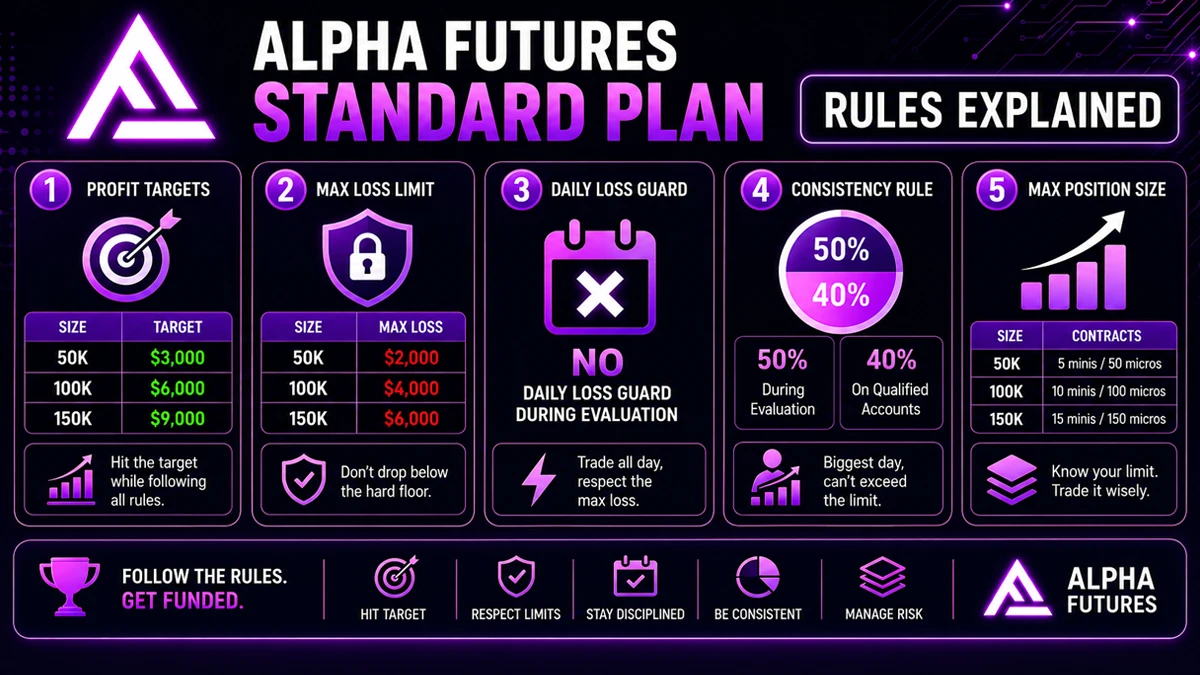
Most traders do not miss the Alpha Futures Standard Plan because the profit target is too high. They fail because one rule violation can erase days of progress, especially when sizing gets emotional or risk is ignored near the finish line.
Profit Targets
Each account size has a fixed profit target that must be reached while all rules remain intact.
Account Size | Profit Target |
|---|---|
Standard 50K | $3,000 |
Standard 100K | $6,000 |
Standard 150K | $9,000 |
These numbers scale cleanly with account size, which makes planning easier. A trader on the 50K account needs $3,000, so ten sessions averaging $300 could complete the challenge without needing a hero trade.
A trader on the 100K plan could reach $6,000 through twelve sessions averaging $500, or fewer stronger days if consistency rules are respected.
Another useful way to judge value is the target-to-cost ratio. The 50K account costs $79 monthly for a $3,000 target, while the 100K costs $159 for a $6,000 target.
Many traders view this as balanced pricing because larger fees come with proportionally larger objectives and room.
Maximum Loss Limit
The maximum loss limit is the account’s hard floor. If equity drops below it, the evaluation fails.
Account Size | Maximum Loss Limit |
|---|---|
Standard 50K | $2,000 |
Standard 100K | $4,000 |
Standard 150K | $6,000 |
Drawdown room matters more than many traders realize. A trader risking $250 per setup on a 50K account has less room for mistakes than someone risking the same amount on a 100K plan. Larger room can reduce panic exits and forced recovery trading.
For example, two losing trades and one slippage event can feel manageable on a 100K account, while the same sequence may create pressure on a smaller plan.
Daily Loss Guard
A major advantage of the Standard plan is simple: there is no daily loss guard during the evaluation.
Many prop firms freeze trading after one bad day. Alpha Futures allows you to keep trading as long as the maximum loss rule is still respected. That gives disciplined traders the chance to reset, wait for higher-quality setups, and recover intelligently instead of being locked out.
If you lose $600 early, you are not automatically shut down. You can step back, wait for the afternoon session, and trade again if conditions improve. Freedom helps skilled traders. It can also punish impulsive traders who revenge trade.
Consistency Rule
Alpha Futures uses consistency rules to reward stable performance rather than one oversized win.
50% consistency rule during evaluation
40% consistency rule on Qualified Accounts
If total profit is $4,000, your biggest winning day cannot exceed $2,000. If total profit is $5,000, your largest day cannot exceed $2,000 because 40% is the limit. This means stacking several solid sessions often works better than trying to hit target in one aggressive move.
Maximum Position Size
Account Size | Contract Limits |
|---|---|
Standard 50K | 5 minis / 50 micros |
Standard 100K | 10 minis / 100 micros |
Standard 150K | 15 minis / 150 micros |
Position limits define how much exposure you can carry at one time. Traders using micros gain flexibility to scale in gradually, while mini contracts create faster P&L movement.
A disciplined trader might use 3 micros to test an entry, then add size only after confirmation. Another trader may use full size immediately and hit drawdown faster. Bigger limits create opportunity, but controlled execution is what actually passes evaluations.
Ready to start? Use SOPF for the best available discount.
Alpha Futures Standard Account Payout Rules
Once you pass the evaluation, your focus usually changes immediately. Profit targets are behind you, and the next question becomes how the Alpha Futures Standard Plan payout rules work in real trading conditions.
If you understand payout timing, consistency requirements, and split percentages early, you can manage profits smarter instead of creating delays with avoidable mistakes.
Withdrawal Qualification
Before you can request an Alpha Futures Standard Plan payout, you need to meet the Qualified Account standards tied to consistency. Alpha Futures wants to see that profits came through repeatable execution, not one oversized day that inflated your balance.
Main requirements include:
You must stay within the 40% consistency rule
Payout requests can be submitted every 14 days on their Qualified Account
Your account must remain in good standing with no rule breaches
If your account shows $5,000 in total profit, your largest winning day cannot be more than $2,000. If one session produced $3,000 and the rest of your gains came slowly after that, you may need additional balanced days before becoming payout eligible.
For many traders, the easiest path is spreading gains across several solid sessions instead of trying to make the entire month in one trade.
Withdrawal Limits
Alpha Futures gives you room to withdraw small or large amounts depending on performance.
$200 minimum payout request
$15,000 maximum payout request per account
That minimum is useful if you prefer taking profits regularly instead of waiting months. The larger cap matters if you build momentum and want to pull meaningful cash without slicing profits into many tiny requests.
If you run multiple qualified accounts, each account can qualify under its own limits. A trader with two profitable accounts may have far more flexibility than someone relying on one account alone.
Profit Split Structure
The Standard plan rewards traders who stay profitable over time.
70% split on payouts 1 and 2
80% split on payouts 3 and 4
90% split on payout 5 and beyond
If you request $10,000 during your first payout cycle, you would keep $7,000 under the 70% tier. Reaching the 90% tier later would turn that same $10,000 into $9,000 kept by you.
That difference is why many experienced traders focus on account longevity, not just the first withdrawal.
What This Means for Real Traders
If you treat the Alpha Futures Standard Account payout model as a short sprint, you may cash out once and lose momentum.
If you treat it as a long-term system, you can grow into the stronger split tiers and keep more of what you earn. In practical terms, steady monthly payouts at 80% to 90% can outperform one rushed withdrawal followed by an account breach.
Biggest Benefits of the Alpha Futures Standard Account
A monthly fee only tells part of the story. What usually decides if an evaluation is worth buying is how the rules behave once real trades start, especially after a losing day, near the profit target, or when it is time to request a payout.
The Alpha Futures Standard Plan has several practical advantages that can make the experience smoother for disciplined traders.
No Daily Loss Guard on Evaluations
One of the most useful parts of the Alpha Futures Standard Account rules is the absence of a daily loss guard during the evaluation phase.
Many prop firms cap your daily loss and stop trading access once that number is hit. Even if your setup appears later in the session, you are done. Alpha Futures instead centers the evaluation around the total maximum loss limit.
If you start the morning down $500 on a 50K account, you are not automatically locked out. You can shut the platform, review mistakes, and come back later when liquidity improves or a cleaner trend develops.
Traders who specialize in the U.S. afternoon session often value that flexibility because weak morning price action does not ruin the entire day. Freedom only helps if you use it correctly. Traders who revenge trade can still damage the account quickly.
Large $15,000 Withdrawal Cap
The Alpha Futures Standard max payout matters because payout caps control how quickly profits become real withdrawals.
Standard Plans allow:
$200 minimum request
$15,000 maximum request per account
A trader with $16,800 in eligible profits can request most of it in one cycle instead of spreading withdrawals across multiple months.
That can matter if you use trading income to fund another account, cover living costs, or simply prefer faster access to capital. Large caps are often overlooked until profits are already there.
Strong Drawdown Ratios Across All Sizes
Usable drawdown often matters more than the advertised account balance.
50K account: $2,000 max loss
100K account: $4,000 max loss
150K account: $6,000 max loss
Suppose your average stop is $250 per trade. On a 50K plan, eight full losses can end the account before commissions or slippage are considered. On a 100K plan, the same risk profile gives much more room to absorb variance and keep executing the strategy normally.
That extra space can reduce panic decisions, rushed exits, and emotional attempts to win losses back immediately.
Lower Reset Costs Than Many Competitors
Even profitable traders fail evaluations sometimes. A bad CPI reaction, an oversized trade, or one emotional session can wipe out progress built over two weeks.
Standard reset costs remain relatively accessible:
50K reset: $59
100K reset: $129
150K reset: $199
If you were three days away from passing a 50K challenge and break the account by mistake, a $59 reset is easier to recover from than paying another full subscription elsewhere.
Clear Path for New Futures Traders
Many newer traders struggle because some prop firms bury them under layered restrictions, hidden timing rules, trailing drawdowns, or payout conditions that only become obvious later.
The Standard plan is easier to map out in advance. You know the target, the maximum loss, the Alpha Futures Standard Plan consistency requirement, the reset price, and the payout structure before the first trade.
That means you can build a real plan. For example, a trader on the 50K account might decide to risk $150 per setup, stop after two losses, and aim for $300 to $450 on winning days. With clear numbers in front of you, risk management becomes measurable instead of emotional.
Start your Alpha Futures Standard Plan today with code SOPF.
Common Mistakes Traders Make on the Standard Account
The Alpha Futures Standard plan is not hard to understand, but it becomes difficult when traders stop treating the rules like numbers and start trading emotionally.
Most mistakes happen at predictable points: after an early loss, after a strong green day, or when the account is close to passing.
Violating the 50% Consistency Rule
The 50% rule means your largest winning day cannot make up more than half of your total evaluation profit. This matters because a profitable account can still be delayed if one day is too large compared with the rest of the balance.
On a 50K account, the target is $3,000. If you make $1,900 on day one, you have not technically built a clean pass yet because that one day is already more than 50% of the target. You would need more profit on later days to balance the result.
A cleaner path looks more like:
Day 1: $700
Day 2: $550
Day 3: $650
Day 4: $500
Day 5: $600
That gets you to $3,000 without one day carrying the whole evaluation.
Oversizing Near the Profit Target
A lot of traders pass 80% of the challenge properly, then fail during the final few hundred dollars. The mistake usually starts with a thought like, “I only need $400 more.”
On the 100K account, the target is $6,000. If you are sitting at $5,650, there is no reason to suddenly trade full size just to finish faster. One bad NQ move can turn a nearly passed evaluation into a reset.
The better approach is boring but safer: keep the same contract size that got you close.
Treating No Daily Guard as Unlimited Risk
No daily loss guard during evaluation is a benefit, but it can also expose poor discipline. Alpha Futures may not stop you after a red morning, so you need your own cutoff.
If you are down $800 on a 100K account, continuing to trade without a plan can quickly turn a manageable loss into a maximum loss problem. A serious trader might set a personal stop at 2 losing trades or 25% of total drawdown for the day.
Choosing the Wrong Account Size
The cheapest option is not always the smartest option. A 50K account at $79/month works well if you trade micros and use tight risk. It can feel restrictive if you trade wider stops or scale into positions.
A trader who normally risks $300 per setup has only a few clean mistakes available on the 50K account before pressure builds. The 100K account gives more room, while the 150K account makes sense only if you already know how to manage larger size.
Forcing Trades to Finish Faster
Monthly billing can make you rush, especially when renewal is close. That pressure causes bad entries, late-session trades, and oversized positions.
The Alpha Futures Standard qualified account rules still require consistency after passing, so rushing the evaluation does not help if your habits break down later. Passing with controlled trades matters more than passing one day sooner.
How to Pass the Alpha Futures Standard Plan Faster
Passing faster does not mean trading bigger or forcing every setup. The fastest clean pass usually comes from reducing mistakes, planning the numbers before the session starts, and treating the evaluation like a controlled sequence instead of a race.
Pick the Right Size for Your Strategy
Start with the account that fits your normal execution. If you trade micros and usually risk $100 to $200 per setup, the 50K plan can work well because the $3,000 target is realistic without needing aggressive size.
f your setups need wider stops or you scale into ES or NQ positions, the 100K plan gives more breathing room with a $6,000 target and $4,000 max loss. A bigger account only helps if your risk process is already stable.
Track Daily Progress Toward Target
Break the target into smaller checkpoints before you trade.
50K target: $3,000, or 10 days at $300
100K target: $6,000, or 12 days at $500
150K target: $9,000, or 15 days at $600
These numbers give you a pace to follow. You do not need to hit the same amount daily, but you should know when you are ahead, behind, or starting to force trades.
Spread Profits Across Sessions
The 50% consistency rule means one huge day can slow the pass instead of helping it. If you make $1,800 on a 50K account, you still need enough additional profit to keep that day under half of total gains.
A cleaner path is stacking days like $450, $700, $550, $600, and $700. That feels slower, but it keeps the account healthier.
Protect Gains Near Completion
Many traders get careless when only a small amount is left. If you need $350 more to pass, reduce risk instead of increasing size. One full-size loss near the finish line can undo several good sessions.
Keep Risk Static Until Passed
Do not double size just because the account is green. Use the same risk plan that created the progress, then adjust only after passing and understanding the qualified account rules.
Alpha Futures Standard Plan vs Zero Plan
Once you understand how the Standard plan works, the next logical question is simple: should you choose the Alpha Futures Standard Account or the Zero Account?
Both are legitimate options, but they are built for different traders, different risk preferences, and different payout priorities.
Feature | Alpha Futures Standard Plan | Alpha Futures Zero Plan |
|---|---|---|
Best For | Traders who want balanced rules and long-term scaling | Traders who want no activation fee and a simpler start |
Monthly Pricing | Starts at $79 | Starts at $79 |
Activation Fee | $149 after passing | $0 |
Evaluation Style | 1-step challenge model | 1-step challenge model |
Daily Loss Guard | None during evaluation | Daily guard applies |
Profit Split | 70% to 90% progressive | 90% fixed |
Max Payout | $15,000 per request | $1,000 - $2,500 depending on account size |
Best Trading Style | Consistent traders building over time | Traders aiming for faster early payouts |
When the Standard Account Makes More Sense
The Alpha Futures Standard Plan usually appeals to traders who want more room to operate and stronger long-term payout potential. If you value no daily loss guard during evaluation, larger withdrawal caps, and a structured progression model, Standard often feels more flexible once you are in rhythm.
A trader producing steady monthly gains may prefer growing into the 90% split tier while using the higher payout ceiling.
When the Zero Account Makes More Sense
The Zero plan often attracts traders who want to avoid the Alpha Futures Standard plan activation fee and move directly into a payout-eligible stage after passing. It can also appeal to traders who prioritize an immediate 90% profit split instead of capped payout limits.
Standard Plan users can use this comparison to understand how the rules differed from the current Zero Account.
Which One Is Better?
Neither account is automatically better. If you prefer structure, room, and scaling upside, Standard is often the stronger fit. If you care most about no activation fee and immediate payout percentages, Zero may suit you better. The best account is usually the one that matches how you actually trade.
Standard plan your best fit? Use SOPF before checkout.
Final Thoughts on the Alpha Futures Standard Account
The Alpha Futures Standard Account suits traders who want a balanced evaluation with realistic room to trade, clear profit targets, and strong payout potential after passing.
It stands out because no daily loss guard during evaluation gives disciplined traders more flexibility, while drawdown limits and consistency rules still reward controlled performance.
Traders who treat the account like a business often get more value than those chasing one fast pass. If you want a structured path with solid upside, the Standard plan deserves serious consideration.
Start today and apply code SOPF for the best available discount.
Continue Learning About Alpha Futures
Alpha Futures Hub Page – Everything Alpha Futures: rules, restrictions, accounts, pricing, and FAQ.
Alpha Futures Zero Plan Explained - Complete guide covering evaluation and qualified account rules, payout requirements, and cost.
Alpha Futures Discount Code – Learn how to apply the SOPF code and reduce your evaluation cost.
All Current Prop Firm Promotions – Compare discounts and deals across prop firms.
Alpha Futures Help Center - The official Alpha Futures Help Center.
Alpha Futures Standard Plan FAQs
What is the Alpha Futures Standard Plan?
The Alpha Futures Standard Plan is a monthly futures trading evaluation that allows traders to qualify for a payout-eligible qualified account by reaching a profit target while following risk management rules. Traders must stay above the maximum loss limit, follow the consistency rule, and respect position size limits throughout the evaluation.
What are the Alpha Futures Standard Plan payout rules?
The Alpha Futures Standard Plan payout rules require traders to satisfy the 40% consistency rule before requesting a payout from a Qualified Account. Payout requests start at $200 and can be as high as $15,000 per account. Traders receive a 70% profit split on payouts one and two, 80% on payouts three and four, and 90% beginning with payout five.
Does the Alpha Futures Standard Plan have an activation fee?
Yes. The Alpha Futures Standard Plan requires a $149 activation fee after passing the evaluation. The activation fee is paid once when moving into a Qualified Account and applies regardless of account size.
What are the Alpha Futures Standard Plan rules?
The Alpha Futures Standard Plan requires traders to reach a profit target while staying above the maximum loss limit and following the consistency rule. The evaluation uses a 50% consistency rule, does not include a daily loss guard, and limits the maximum number of contracts based on account size.
Is there a daily loss limit on the Alpha Futures Standard Plan?
No. The Alpha Futures Standard Plan does not use a daily loss guard during the evaluation phase. Traders can continue trading after a losing session as long as they remain above the account's maximum loss limit and continue following all other evaluation rules.
How does the Alpha Futures Standard Plan consistency rule work?
The Alpha Futures Standard Plan uses a 50% consistency rule during evaluation and a 40% consistency rule on Qualified Accounts. This means a trader's largest winning day cannot exceed the stated percentage of total profits. The rule is designed to encourage steady performance rather than passing through a single oversized trading day.
Alpha Futures Standard Plan vs Advanced: What's the difference?
The Alpha Futures Standard Plan uses a progressive 70% to 90% profit split, requires a 40% consistency rule on Qualified Accounts, and allows payouts every 14 days. The Advanced Plan pays a fixed 90% profit split, has no consistency requirement, and allows payouts every 5 days.
Is the Alpha Futures Standard Plan still available?
No. Alpha Futures retired the Standard Plan on May 1, 2026, and replaced it with the Premium Plan. Existing Standard Plan users may still reference the original rules and account structure, but new traders can no longer purchase a Standard Plan evaluation. Traders looking for the current offering should review the Alpha Futures Premium Plan instead.
Disclaimer: This article contains affiliate links. If you sign up for Alpha Futures using our links or the SOPF discount code, we may earn a commission at no additional cost to you. This helps support our site and allows us to continue providing free information.
The Alpha Futures Standard Plan was retired on May 1, 2026, and replaced by the Premium Plan. This article is provided for informational and historical reference purposes only.
Pricing, rules, payout policies, account requirements, platform features, and available plans may change at any time. Always verify the latest information directly with Alpha Futures before making a purchase or trading decision.
Futures trading involves substantial risk and is not suitable for all investors. Prop firm evaluations require skill, discipline, and risk management. Past performance does not guarantee future results.
Evaluation and Qualified Accounts operate in a simulated trading environment unless otherwise stated by Alpha Futures. Individual trading results will vary, and no representation is being made that any trader will achieve similar results.
For additional information, please review our Disclaimer page. If you notice an error or have a question about this article, please contact us.
Alpha Futures Zero Account Guide: Rules, Payouts and Cost
Learn how the Alpha Futures Zero Plan works with exact rules, pricing, payout requirements, and profit split. See how to pass the evaluation and start getting payouts fast.

Complete LucidBlack Guide: 3-day Payouts & 2x Bonus System
Complete guide to LucidBlack covering 3-day payouts, 2x bonus system, evaluation rules, funded account requirements, 40% consistency, contract scaling, LucidLive transition, and detailed comparisons with LucidFlex, LucidPro, and LucidDirect.
Nexgen ProTrader Funding Evaluation Questions Answered
A complete breakdown of how the Nexgen ProTrader Funding evaluation works, covering account sizes, drawdown mechanics, trading rules, platforms, and what happens after you pass.